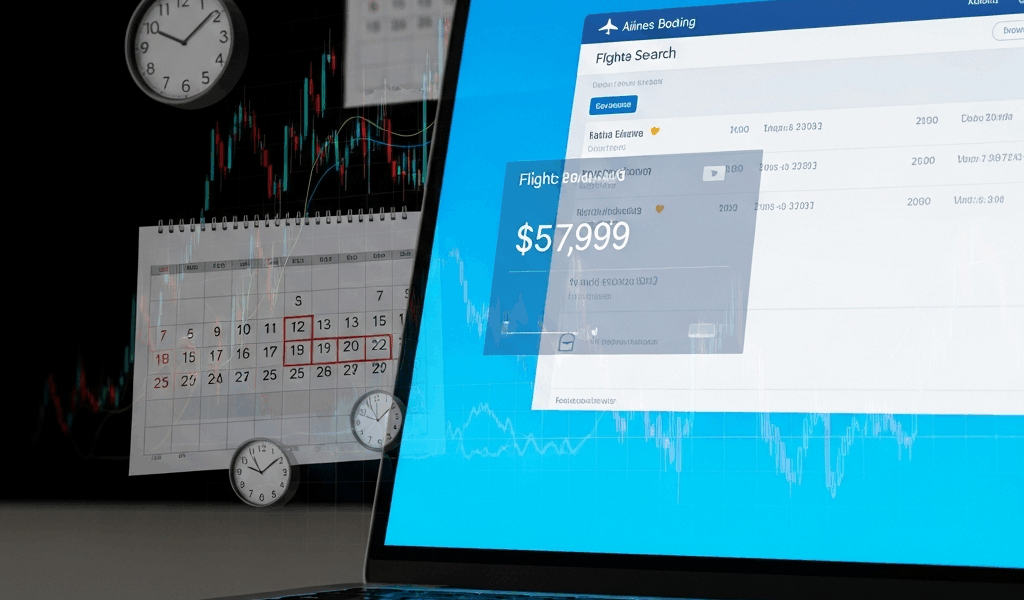
Airline Pricing Is harder than it needs to be With All the Myths Flying Around
Prices shift every hour. Most travelers blame chaos or conspiracy. Neither is right. Airlines run a mechanical system — and once you see how it actually works, the whole thing becomes almost predictable.
But what is dynamic pricing? In essence, it’s a system where each flight gets divided into invisible fare buckets — fixed groups of seats at fixed prices. But it’s much more than that. Picture a venue where the first 40 seats cost $180, the next 30 cost $240, and the remaining 20 cost $320. When the $180 group sells out, the system automatically opens the $240 group. No airline employee flipped that switch. An algorithm did it the moment inventory crossed a threshold.
Some flights run as many as 26 distinct buckets. Each holds a set number of seats. One empties, the next opens. Someone books a seat at 2:14 p.m. — inventory shifts. The algorithm recalculates. Price moves. This happens constantly, all day, across every route.
Here’s the part most travelers never hear: the system resets every morning at 12:01 a.m. Bucket inventories refresh for future flights. That flight you checked at 11 p.m. showing $310? It might show $249 at 8 a.m. Not because demand dropped overnight — because the buckets literally reset. That was information worth $60, and it was free.
The Specific Triggers That Push Prices Up Fast
Frustrated by watching a $220 fare jump to $310 in six hours, I started tracking exactly when prices moved and why. Four concrete triggers explain nearly every spike. Recognizing them means you stop blaming bad luck and start seeing the pattern.
Seat Inventory Crosses a Bucket Threshold
This one drives most of what you see. A Denver-to-Las Vegas flight releases 40 seats in the $199 bucket. Thirty sell on Tuesday afternoon. Ten remain. Wednesday morning, those last ten go. Algorithm activates the $249 bucket. You search Wednesday evening — you see $249. Demand didn’t surge. Supply in that specific pricing tier just ran dry. Two completely different things.
Competing Airlines Trigger Automatic Price Matching
Delta’s system monitors United’s fares on shared routes in near real-time — we’re talking minutes, not hours. United drops Atlanta-to-Miami from $310 to $275 at 2 p.m. Delta’s algorithm catches it by 3:10 p.m. and auto-matches. You searched at 2:00 and saw $310. You searched at 3:15 and saw $285. You weren’t imagining things. You just caught the window between a competitor’s move and the algorithm’s response. That window is narrow. Usually 45 minutes to two hours, depending on the route.
Search Volume Signals Demand Pressure
When Google Flights, Kayak, and Hopper collectively register around 14,000 searches on a specific route in a single day — which is genuinely high traffic — airline systems read that as demand pressure. It doesn’t rewrite the bucket structure itself, but it influences how aggressively airlines release inventory into lower tiers. Heavy search volume can accelerate cheap-bucket depletion. Essentially, curiosity from thousands of browsers nudges the algorithm toward burning through discounted seats faster.
Day-of-Week and Hour-of-Day Windows
Tuesday afternoons and Wednesday mornings carry the lowest search volume of the week. Airlines release deeper discounts more freely during those windows — there’s less competition for seats, and the algorithm responds accordingly. Sunday evenings are peak demand. Wednesday at 11 p.m. is a dead zone. Friday at noon? Highest prices of the week on most leisure routes. Saturday mornings drop slightly. Airlines have 15-plus years of booking data proving these patterns down to the hour. Their algorithms price accordingly, every single day.
Okay, here’s the thing nobody tells you. Most people search for flights every evening around 6 p.m. — peak search hours — and wonder why prices feel stuck at the high end. They’re not stuck. They’re just reflecting what peak-hour inventory depletion looks like in real time.
Does Searching a Flight Actually Make It More Expensive?
You’ve heard it a hundred times. Clear your cookies. Use incognito mode. The airlines are tracking you and punishing repeat searches with higher prices.
Frustrated by how persistent this myth is, I dug into where it actually comes from — and there’s a sliver of truth buried in there, badly misunderstood. Some third-party aggregators — not the airlines themselves — do occasionally show marginally different prices based on session history. I’m apparently a Kayak-shows-higher-prices person, and Google Flights works for me while Kayak never seems to land on the same number. That’s real. Cookies can influence which tier a third-party site surfaces first. A $229 fare on Kayak and a $221 fare on Google Flights for the identical seat isn’t a conspiracy — it’s aggregator logic.
But American Airlines, Southwest, United — none of them are watching your browser history. Their algorithms care about two things: inventory levels and competitor pricing. Your device, your cookies, your search count from yesterday — irrelevant.
What actually determines the price you see: whether a bucket in your range still has capacity. Full stop.
Don’t make my mistake of spending 20 minutes clearing cache and switching browsers before every search. That time is better spent understanding bucket depletion and setting alerts on multiple platforms. The incognito rabbit hole is a dead end. It always was.
How to Stop Chasing and Start Timing Prices Correctly
So While you won’t need to become a full-time airfare analyst, you will need a handful of tools and a repeatable process.
- Set a price alert on Google Flights and Hopper simultaneously. You want two data streams running at once. Google Flights surfaces historical pricing context — what this route has actually cost over the past 60 days. Hopper predicts future movement using machine learning trained on billions of fare data points. Together they give you directional signals and historical grounding. One without the other is half the picture.
- Identify which bucket you’re actually in. First, you should write down the exact fare you first see — at least if you want any real reference point later. Say it’s $240 on a Thursday. That’s not your floor. That’s your entry point. Track how often the price drops below $240 over the following week. If it hits $210 twice, you’ve confirmed cheaper buckets exist and are accessible on this route. That’s actionable data. A single number in a screenshot is not.
- Use the 24-hour rule like a tool, not a safety blanket. U.S.-originating flights are legally held at the quoted price for 24 hours — you can book and cancel within that window for a full refund, no fees. Book the $240 fare today. If a lower bucket activates in the next 23 hours and the price drops to $210, cancel and rebook. The airline cannot charge a change fee for this. It’s not a loophole. It’s federal law — the DOT’s 24-hour reservation requirement, in place since 2012.
- Recognize an actual buying window. A price drop might be the best signal to act on, as airfare tracking requires distinguishing real bucket activations from rounding noise. That is because a 12–15% drop below your two-week average almost always reflects genuine inventory shift. A flight averaging $320 that falls to $278 is showing you something real. A flight that drops from $321 to $319 and bounces back in 40 minutes? That’s variance. Don’t act on noise. The distinction matters more than the dollar amount.
When You Should Just Book and Stop Watching
Here’s the part nobody wants to hear: there is no perfect moment. It doesn’t exist.
Wait long enough on any route and you’ll find a lower price somewhere in the timeline. You’ll also find yourself staring at a $410 fare because you refused to book at $240. That’s what makes the 24-hour rule endearing to us obsessive fare-watchers — it removes the paralysis. I learned the hard way on a Miami flight last February, tracking a reasonable $195 fare for nine days while it quietly climbed to $410 by the week I actually needed to book. Nine days of alerts. Zero action. One expensive lesson.
Use this rule: if the current fare sits within 10% of the lowest price in your two-week alert history, book it. Not after one more check. Not after you try that other browser. Book it now. That 10% variance lives inside the pricing bucket — it’s noise, not signal. The next meaningful drop may never come. And if it does, the 24-hour cancellation window is your actual safety net — not hesitation.
The psychological trap is real. The moment you book, it feels certain that prices will fall. They won’t fall on a schedule that cares about your purchase. You just stop watching — and that feels like confirmation of bad timing. It isn’t. The flight doesn’t know you bought it.
Book when the fare fits your budget and your dates align. That’s the window. Not some imaginary perfect price that only exists once the trip is already behind you.


Leave a Reply