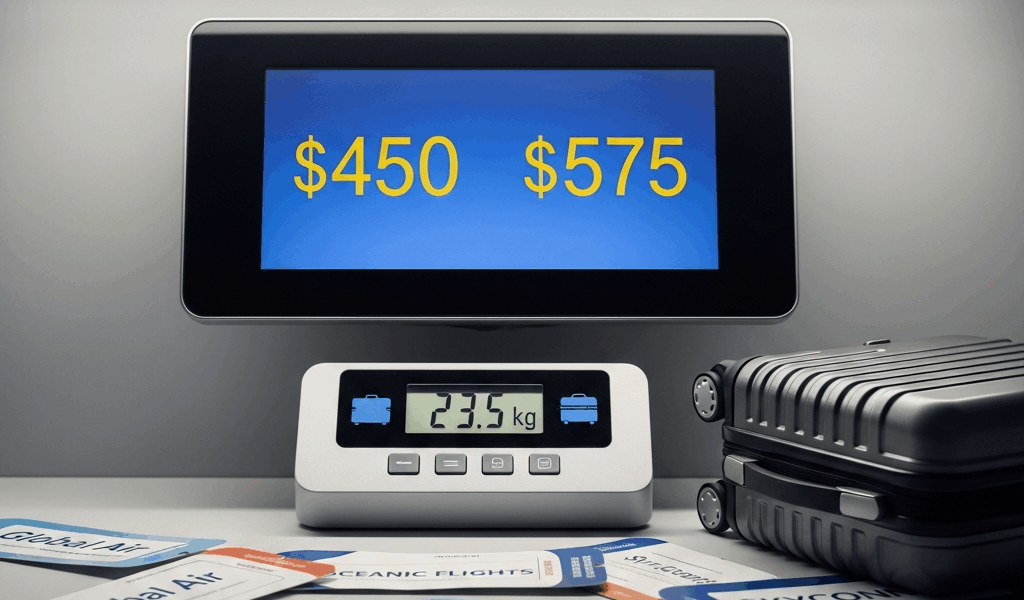
The Gate Is the Most Expensive Place to Pay for a Bag
Airline bag fees are a maze now with all the fine print flying around. Last spring I was standing in a Southwest boarding line — wrong airline, long story — and watched the woman ahead of me get hit with a $65 fee for a single checked bag. I’d paid $35 for the exact same thing the week before on the same carrier. She looked genuinely blindsided. Honestly, so was I, until I started actually digging into how this works.
This is not a glitch. Not a mistake. It’s deliberate.
American Airlines charges $35 online. At the gate? $50. Delta: $35 online, $50 at the gate. United runs $40 online, $50 at the counter, and $65 if you wait until you’re standing at the jetway. Spirit — which monetizes luggage the way other carriers monetize seat selection — charges $32 online, $47 at the airport counter, and $65 at the gate itself. The markup lands somewhere between 40 and 86 percent depending on the carrier and the moment you realize you need that bag.
Burned by fees you didn’t see coming? You’re not alone. Travelers search this exact problem constantly because it feels punitive. And honestly, it is designed to be.
Why Airlines Charge More at the Gate
But what is a gate bag fee, really? In essence, it’s a last-minute surcharge tacked onto checked luggage added after you’ve already reached the boarding area. But it’s much more than that — it’s a behavioral penalty baked into the pricing architecture on purpose.
When you prepay online or through the app, you commit early. That commitment lets the airline forecast exactly how much cargo weight is going on each flight. Weight distribution affects fuel burn, load balancing, ground crew scheduling — real operational stuff. If a carrier knows three days out that Flight 247 will carry 140 checked bags, they can pre-stage the ground crew, load the plane efficiently, and run tighter operations. That certainty has actual dollar value to them.
Gate fees are not service charges. They are penalties. Airlines dress them up as “standby bag fees” or “gate check fees,” but the intent is plain: punish you for waiting. When you show up at the gate with an unpaid bag, you’ve created operational chaos. The flight is already loaded. Weight calculations are done. Ground crew is staged. Your bag forces a recount, a rebalance, and a manual intervention during the 30 busiest minutes of airport operations.
Gate agents scan your boarding pass and see instantly whether that bag fee cleared your account days ago or whether you’re trying to add it right now. The system flags it. That’s not coincidence — it’s architecture.
The surcharge is pure behavioral economics. Make the penalty steep enough and travelers prepay next time. This works. Most people learn once. The fee structure counts on exactly that.
What Each Major Airline Charges at the Gate vs Online
Here’s what you actually pay depending on when and where you add a checked bag:
| Airline | Online/App (Prepay) | Airport Counter | Gate |
|---|---|---|---|
| American | $35 | $40 | $50 |
| Delta | $35 | $40 | $50 |
| United | $40 | $50 | $65 |
| Spirit | $32 | $47 | $65 |
A few exceptions exist worth knowing. Elite status holders — American Platinum, Delta Gold or higher, United Silver or above — fly with that first bag free regardless. The gate surcharge doesn’t touch you because you’re not paying in the first place. Co-branded credit cards work similarly. The American Airlines AAdvantage card, the Delta SkyMiles Reserve, the United Gateway card — all cover that first checked bag on your own reservation. These perks are one of the few genuinely legitimate reasons to carry an airline-branded card, honestly.
Real talk: this is the important bit. — Southwest includes two free checked bags for every passenger, no exceptions. That’s what makes Southwest endearing to us frequent travelers who haul gear. I apparently booked a connecting leg on a different carrier without realizing it, and that carrier most definitely does charge bag fees. Don’t make my mistake.
When You Can Still Add a Bag Without the Gate Penalty
Timing matters here. The window is narrower than most people expect.
The safest window is 24 to 48 hours before departure — right when online check-in opens and the airline app becomes fully functional. Every major carrier lets you add a checked bag through their mobile app during this stretch at the prepaid price. You don’t need to be at the airport. You don’t need to call anyone. Open the app, tap “Add Bags,” pay your $35 to $40, and move on. Done in about 90 seconds.
Your next best option is the airport counter, usually open two to three hours before domestic departures. You’ll pay slightly more — $40 to $50 depending on the airline — but you’re still well under the gate maximum. Fine if you want to confirm bag details face-to-face, though for most trips it’s unnecessary.
Many airlines freeze online bag purchases once check-in closes. That’s typically 30 minutes before departure for domestic flights, 45 minutes for international. After that cutoff, the gate is your only option. Some airports have bag drop kiosks in the terminal, and United and Delta at major hubs sometimes run baggage service desks that stay open past ticketing counter hours — these charge either counter or gate prices depending on the location. Call ahead if you’re cutting it close.
Here’s what actually happens when you don’t prepay: you walk up to the gate, the agent scans your boarding pass, the system shows no bag fee on your reservation, and they quote you the gate price right there. You pay it or the bag doesn’t fly. No negotiating. No retroactive prepay at the lower rate. There’s simply no mechanism for that.
How to Never Pay a Gate Bag Fee Again
- Prepay during booking. Add bags the moment you buy your ticket. The fee is at its lowest and you’re already making luggage decisions anyway — might as well finish the job.
- Use the airline app the day before. Set a phone reminder for 24 hours before departure. Open the app, add your bags, confirm your seat. It takes under two minutes and saves you $15 to $25 depending on the carrier.
- Know what your credit card actually covers. If you carry an airline-branded premium card, that first checked bag is free on your own reservation. If not, run the math — the annual fee rarely makes sense unless you’re flying that specific carrier more than four times a year.
- Choose a bag-friendly airline for regular routes. Southwest’s two free checked bags change the math entirely if you travel a particular route often. That’s what makes their model endearing to us road warriors who are tired of nickel-and-dime surcharges.
- Pack to avoid checked bags altogether. This is the ultimate gate fee avoidance strategy. Most trips fit into a single carry-on if you pack with actual intention — and most travelers, myself included, historically have not done that.
So, here’s the core of it: paying for a checked bag at the gate runs 40 to 86 percent more than prepaying online. The fee exists because airlines profit from procrastination — yours, mine, everybody’s. Know when you’ll need a bag, add it early, and you’ll never see that surcharge again. It’s not complicated. It just requires action before you’re standing at the boarding podium with your roller bag and your regrets.


Leave a Reply