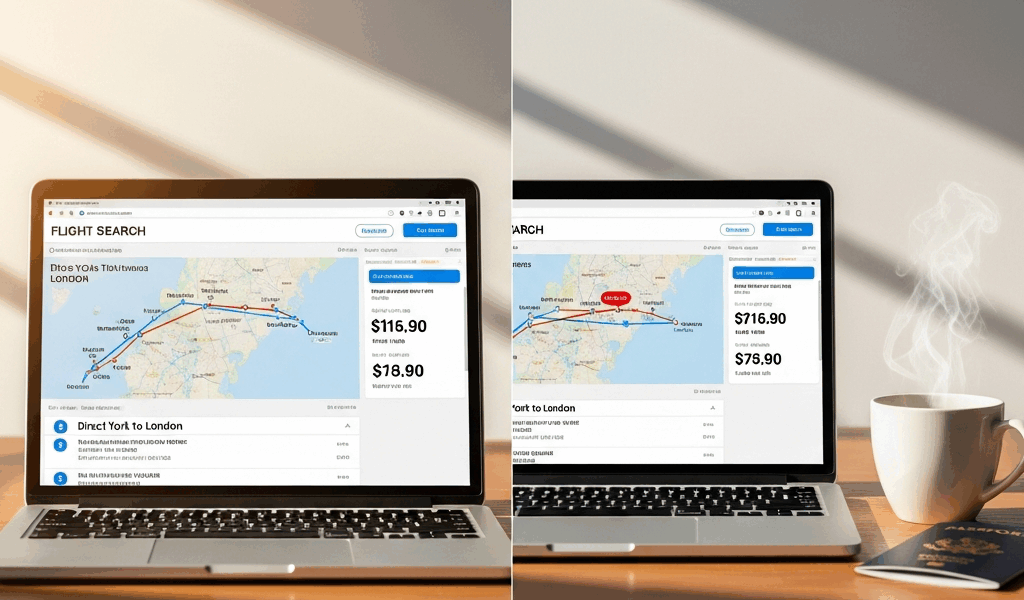
Skyscanner vs Kayak Doesn’t make sense the way it used to With All the Conflicting Advice Flying Around
As someone who books flights obsessively — domestic, international, last-minute, six-months-out — I learned everything there is to know about which search tool actually saves money versus which one just feels like it does. Today, I will share it all with you.
I finally ran a real test instead of toggling between browser tabs out of muscle memory. Six routes total. Three domestic US, two international, one last-minute booking with a 36-hour window. Some results confirmed what I already suspected. One result genuinely surprised me — enough to change which tab I open first now.
Quick methodology: all searches ran within the same two-hour window on a Tuesday morning. Same travel dates, same passenger count (one adult), no loyalty filters on either platform. I recorded the lowest available fare on each, including any Hacker Fare or split-ticket options Kayak surfaced. Routes were JFK–LAX, ORD–MIA, DEN–SEA (domestic), JFK–LHR, LAX–NRT (international), and a last-minute ORD–ATL search for travel the following morning.
Neither tool wins every time. But one wins more often depending on trip type — and knowing that split is worth real money.
Where Skyscanner Consistently Wins
Both international routes went to Skyscanner. JFK–LHR departing six weeks out returned a $489 fare on Norwegian that Kayak never surfaced. Kayak’s lowest was $531 on a legacy carrier. That’s a $42 gap on a single search. Not nothing.
But what is Skyscanner’s actual advantage here? In essence, it’s broader indexing of budget carriers — particularly European and Asian low-cost operators that Kayak’s partnerships don’t always catch. But it’s much more than that. On the LAX–NRT search, Skyscanner found Zipair — a budget subsidiary of Japan Airlines — at $612 roundtrip. Kayak showed $689 as its floor. That’s a $77 difference on a single international booking.
The “Search Everywhere” Feature Is Genuinely Underrated
Stumbled onto this by accident two years ago while trying to plan a trip on a fixed $800 budget. Type in your departure airport, leave the destination blank, and Skyscanner maps fares to hundreds of cities simultaneously. That’s what makes it endearing to flexible travelers who care more about getting somewhere interesting than going somewhere specific. Kayak’s Explore tool does something similar — but the interface feels clunkier and the fare data seemed less current during my testing. Skyscanner wins that comparison without much debate.
One Real Weakness Worth Knowing
The redirect experience is genuinely frustrating. You find that $489 Norwegian fare, click through, land on a third-party booking site you’ve never heard of, and the price has quietly jumped to $509 — with a checked bag fee buried in step three of checkout. It happens often enough to be a pattern, not a glitch. Always verify the final price before entering payment info. Don’t make my mistake.
Where Kayak Pulls Ahead
Domestic routes told a different story. On two of the three US searches, Kayak matched or beat Skyscanner’s lowest fare. On ORD–MIA specifically, Kayak’s Hacker Fare came in at $187 versus Skyscanner’s $214 for a straightforward itinerary. That’s a $27 gap — not dramatic, but real.
Hacker Fares work by booking outbound and return flights as separate one-way tickets on different airlines. That $187 fare paired an American Airlines outbound with a Spirit return. Saves money. Also means two separate reservations, no through-check for luggage, and zero protection if one leg gets delayed and you miss the other. For carry-on-only travelers who aren’t cutting connection times close, it’s legitimate. For anyone checking bags or transiting through O’Hare in February — skip it entirely.
Kayak’s Price Forecast Feature — When It’s Actually Worth Trusting
The fare prediction tool tells you whether prices are likely to rise or fall. Useful in exactly one scenario: you’re searching three to six weeks out on a domestic route and the current fare feels suspiciously high. In that window, the forecast has been directionally accurate in my experience — not perfect, but right often enough to influence timing decisions. Outside that window? Ignore it. Forecasting a transatlantic fare eight weeks out is a guess dressed up as data, and that’s being generous.
One more thing. On the DEN–SEA route, Kayak surfaced a Southwest fare that Skyscanner never showed. Skyscanner doesn’t include Southwest — at all. That gap alone disqualifies Skyscanner as a sole source for domestic US travel. Southwest competes seriously on price across dozens of routes, and flying blind to their fares is just leaving money on the table.
The One Test That Actually Changed My Default
Stopping for a sec — this is the key bit.
The last-minute search was supposed to be throwaway data. Last-minute fares are almost always terrible. Both tools would surface the same depressing options, and the section would confirm what everyone already knows — book early. That’s not what happened.
Searching ORD–ATL for the following morning, Kayak returned $312. Expected. Painful. Skyscanner returned $198 on a Spirit itinerary I’d completely overlooked — not because I was avoiding Spirit, but because the 5:47 a.m. departure had landed in a filter range I’d mentally dismissed. Removed the time filters, looked at the raw fare list — there it was. $114 difference on a last-minute booking.
That result changed my behavior. I’m apparently someone who filters out early departures by instinct, and Skyscanner surfaces those buried Spirit fares while Kayak buries them differently. I now run both searches on any last-minute booking — no exceptions. The gap won’t always be $114. Sometimes it’s $8. But on a $300-plus fare, spending 90 seconds on a second search has measurable expected value.
Humbled by that result, I went back and re-ran two earlier searches with Spirit and Frontier filters removed on Kayak. Skyscanner still surfaced budget carrier options Kayak was missing — but the gap narrowed once Kayak’s Hacker Fares entered the picture. These tools are closer than the headlines suggest. Neither one is running away with it.
Which One Should You Actually Use
So — here’s the actual breakdown:
- Use Skyscanner if you’re booking international flights, want flexible destination search, or are hunting budget carriers outside the US market. The $489 Norwegian fare that Kayak never found is the whole argument.
- Use Kayak if you’re booking domestic US routes, want fare prediction data for three-to-six-week booking windows, or are open to Hacker Fares as a carry-on-only traveler. And Southwest alone makes it mandatory for domestic search.
- Use both on any flight where the fare exceeds $250. Ninety seconds. The savings potential scales directly with ticket price.
Skyscanner edges out Kayak on international routes and budget carrier coverage. Kayak edges out Skyscanner on domestic US fares — and the Southwest gap isn’t a minor footnote, it’s a structural limitation. Neither platform is a permanent winner. That’s the honest summary.
One more thing worth flagging: both platforms are starting to face real competition from AI-powered travel search tools that can factor in layover quality, seat configuration, and historical on-time reliability in ways that Skyscanner and Kayak simply don’t. If you’re curious how those tools compare, there’s a full breakdown of AI travel planning tools that covers the current field in detail. The search experience is changing faster than most travelers realize.
For now — run both. Take the 90 seconds. It’s worth it.




Leave a Reply