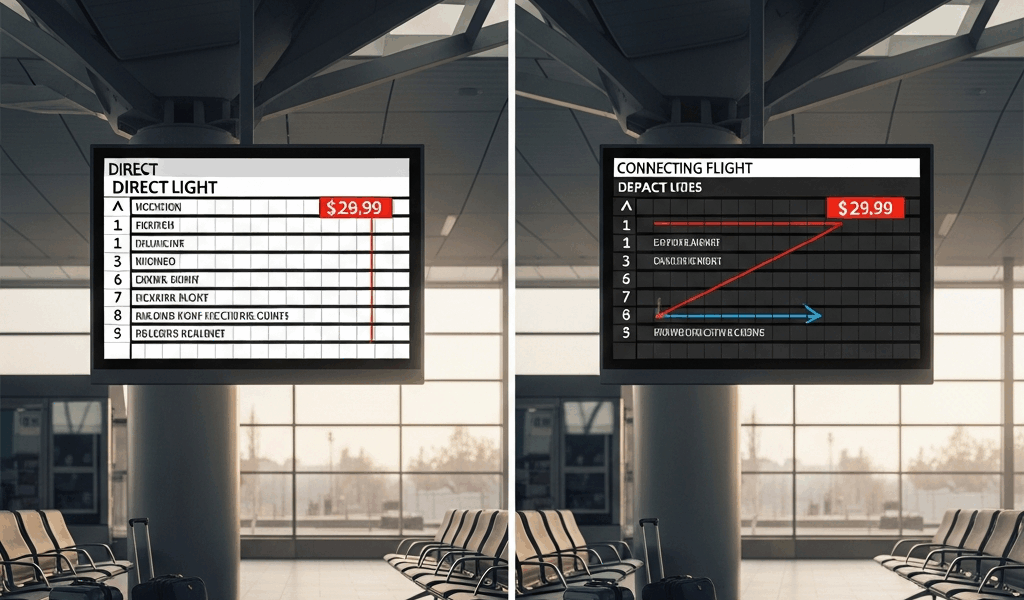
Airlines Charge for Convenience, Not Distance
Flight pricing is way more layered than people realize with all the misinformation flying around. Most people assume airlines charge more based on how far you travel. They don’t. They charge based on demand and competition — and once you understand that, cheaper tickets start appearing everywhere.
I learned this the hard way booking a New York to Los Angeles trip last spring. The United nonstop was $487. Same route, two-hour layover in Denver: $312. That’s $175 for literally the identical origin and destination. I almost missed it entirely because I’d filtered out connecting flights out of habit.
So what is yield management? In essence, it’s airlines charging whatever the market will bear on any given route. But it’s much more than that — it’s a dynamic, constantly shifting calculation that runs in the background of every search you do.
The JFK-to-LAX corridor is brutally competitive. United, American, Southwest — they all know you want that direct flight and will pay a premium to avoid adding hours to your day. So they price accordingly. Nobody blinks at $480 nonstop when the alternative is sitting in Denver for two hours.
But New York to Denver? Denver to Los Angeles? Separate markets entirely. The first leg might have 40 empty seats. The second, maybe 20. An empty seat generates zero revenue — so the airline bundles both legs together at a discount and fills the plane. They still profit. You still arrive. The only thing that loses is your assumption that pricing should make intuitive sense.
The Hidden City Trick — and Why It’s Different From What I’m Teaching
I should’ve put this up front, my bad. A lot of people confuse two very different strategies, and one of them will get you banned from an airline.
Hidden city ticketing works like this: you book New York to Los Angeles with a Denver connection, but you only want Denver. You skip the second leg and walk out of the airport. Cheaper ticket, right destination. Sounds clever. It violates airline terms of service. They can ban your account, claw back your frequent flyer miles, or charge you the fare difference retroactively. Not illegal — but definitely against the rules you agreed to at checkout. Don’t make my mistake of even considering it.
What I’m actually telling you to do is completely different and completely legal. You book the connecting flight. You fly both legs. Every single one. You’re not deceiving anyone — you’re just choosing the smarter itinerary.
New York to Los Angeles with a Denver connection? You board in New York. You land in Denver. You wait. You board again. You land in Los Angeles. That’s it. The airline gets paid in full, your miles post normally, and your account stays untouched. Zero risk.
How to Actually Search for Cheap Connecting Flights on Purpose
Google Flights is the fastest tool for this — at least if you want a clean interface that doesn’t bury the data. Skyscanner works too, but Google shows the price comparison more clearly, so I’ll walk through that one.
Enter your origin, destination, and dates the normal way. Then look at the filter panel. You’ll see a “Stops” option. Most people click “Nonstop” and never look back. That’s the mistake.
Here’s the key move: don’t filter at all yet. Let every option load. Google will show you a price ladder — nonstop results at the top, then one-stop options below. Your job is simple: compare those two numbers on the same route, same dates.
Real figures from an April search, New York to Los Angeles:
- Nonstop: $420 to $680
- 1-stop: $240 to $390
- 2-stop: $180 to $310
That $240 one-stop is the target. Click into it. Google shows layover duration right on the results page — look for something between 90 minutes and four hours. Shorter than 90 minutes and you’re gambling. Longer than four hours and you’ve eaten up most of your savings in wasted time.
Check the connection airport. Denver, Chicago O’Hare, Dallas/Fort Worth, Atlanta Hartsfield — these are major hubs built to move connecting passengers efficiently. That’s what makes them endearing to us deal-hunters. Regional or unfamiliar airports are a different story; click the flight details tab and look at terminal layouts before committing.
Skyscanner works the same way. Enter the route, toggle the Stops filter, sort lowest price first. The deals almost always sit in the one-stop or two-stop tier.
One rule of thumb worth memorizing: the savings gap needs to be at least 15% to be worth your time. Nonstop at $400, one-stop at $380? Pass. Nonstop at $400, one-stop at $300? That’s worth investigating.
When a Layover Deal Is Actually Worth Taking
Not every cheap connecting flight is a good deal. Time has real value. to the five questions worth asking before you book.
- Is the layover between 90 minutes and four hours? Anything tighter is stressful. Anything longer wastes your day.
- Are you checking a bag? The airline should transfer it automatically on a single ticket — but verify before booking, not at the gate.
- Does the price difference top 20% of the nonstop fare? Saving $60 on a $300 ticket probably isn’t worth the extra hassle.
- Is the connection through a major hub? Denver, Atlanta, Chicago, Dallas, Houston — these airports handle volume. Smaller ones, less so.
- Will you arrive within two hours of the nonstop arrival time? Landing at 8 p.m. instead of 6 p.m. is fine. Landing at 11 p.m. instead of 6 p.m. is a different trip entirely.
Four out of five yeses? Book it.
What to Watch For Before You Click Purchase
Tight connections have a way of biting back. I once did a 60-minute layover at O’Hare with a checked bag. The bag did not make the flight. It showed up the next afternoon. I’m apparently someone who learns this kind of lesson by living it, and United’s automated rebooking system works for luggage delays while manual intervention never seems to move fast enough. That was 2019. I still remember the $14 toothbrush I bought at a CVS near my hotel.
The bigger issue: single ticket versus separate tickets. Google Flights and Skyscanner both flag this. If the results show “operated by 2 airlines” or list them under different booking references, you have two separate tickets. A delay on leg one means you’re stranded for leg two — and rebooking comes out of your pocket, not the airline’s. One itinerary number, booked through one airline’s website, gives you protection. They’ll move you to the next available flight if their delay causes you to miss the connection.
Checked bag transfers happen automatically on a single ticket. Separate tickets mean collecting the bag at the connection airport, hauling it to departures, and rechecking it yourself. Factor that into your layover time calculation.
Last thing — download the airline’s app before the trip. Delta’s, United’s, American’s. All of them. If your first leg delays and your connection tightens, the app flags it and sometimes even rebooks you before you land. Not guaranteed, but far better than finding out at the gate with 200 other people having the same problem.
The savings are real. A hundred and seventy-five dollars on a single round trip adds up fast if you fly a few times a year. The inconvenience, managed correctly, is a two-hour wait and a slightly longer travel day. That’s the actual trade-off — and now you know exactly when it’s worth making.




Leave a Reply